Note: Click on a photo to see a larger version
101 years ago marked the start in 1917 of the Battle of Messines in Flanders, Belgium. Messines was part of the southern flank of the infamous Ypres salient during world war one. Although the Battle of Messines was a success for the British and Empire forces involved; it is often overshadowed by Third Battle of Ypres that started barely a month later. The upcoming and larger Third Battle of Ypres is often simply known as Passchendaele.
Here are a (large) number of pictures that I took while travelling around the Ypres area, with my girlfriend Christieann, in June of 2016. Included is a commentary of sorts from my experiences.

Note: In the First World War the British Army used the French language versions of Belgium placenames. Hence the use of Messines, rather than the Dutch language name of Mesen. This was unusual as the British Army was mostly operating in the Dutch-speaking Belgium province of Flanders. Hence the modern signs are in Dutch and French.
Island of Ireland Peace Park
Located within sight of Messines village is an unusual Island of Ireland Peace Park. There are many, so very many, memorials to the fallen of the First World War in this part of the world. This park is unusual as it both serves as a memorial to the fallen, and it serves as a gesture of reconciliation within the sectarian divide of Ireland.

The Peace Park was unveiled in 1998 during the time of the Good Friday Agreement. Building such a memorial at that time was very symbolic to acknowledging and accepting the role of the Irish people in the world wars.

“From the crest of this ridge, which was the scene of terrific carnage in the First World War on which we have built a peace park and Round Tower to commemorate the thousands of young men from all parts of Ireland who fought a common enemy, defended democracy and the rights of all nations, whose graves are in shockingly uncountable numbers and those who have no graves, we condemn war and the futility of war. We repudiate and denounce violence, aggression, intimidation, threats and unfriendly behaviour.
As Protestants and Catholics, we apologise for the terrible deeds we have done to each other and ask forgiveness. From this sacred shrine of remembrance, where soldiers of all nationalities, creeds and political allegiances were united in death, we appeal to all people in Ireland to help build a peaceful and tolerant society. Let us remember the solidarity and trust that developed between Protestant and Catholic soldiers when they served together in these trenches.
As we jointly thank the armistice of 11 November 1918 – when the guns fell silent along this western front – we affirm that a fitting tribute to the principles for which men and women from the Island of Ireland died in both World Wars would be permanent peace.”


Located near the entrance were poems, prose, and letters from Irish servicemen


The four Irish provinces are symbolically represented by four stones.
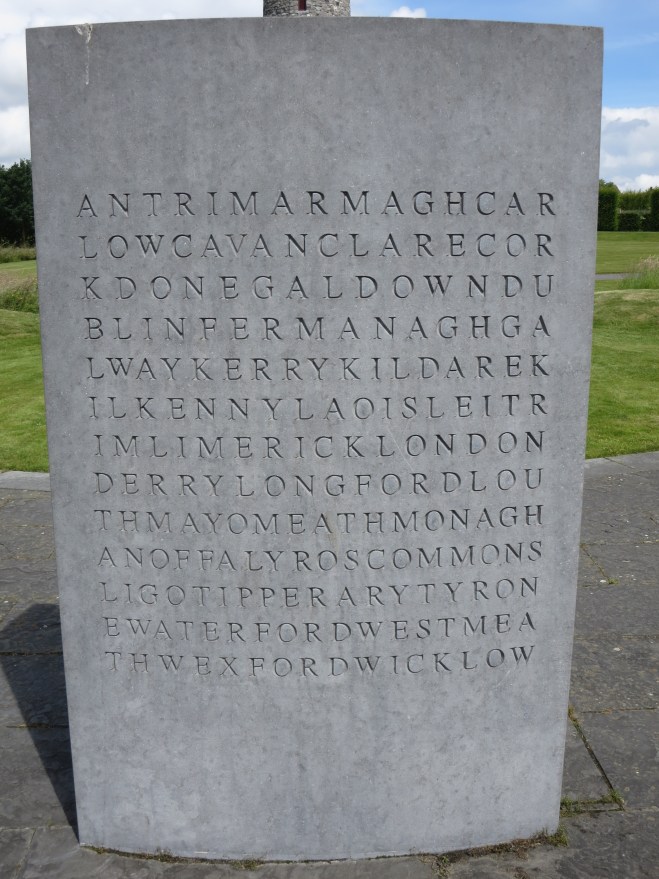

We visited the park early on a fine June day. It was grand to walk around the park with only our footsteps, and the sound of the countryside, to interrupt our thoughts. Located on the gentle rise up to the village of Mesen it has fines views across the surrounding countryside. The park was a great contrast in style and content to many that we saw.
The peace park contrasted greatly with the momuments, cemeteries and memorials that litter France and Belgium. Most of the commenorative construction was done in the period between WW1 and WW2. The peace park is very much a product of the late 1990’s that I doubt could have been constructed earlier. The history of Ireland during WW1 is complicated to say the least. So many Irish served the war effort in the military, the fields, the mines, and in the factories. It is only fair that their efforts are recognised. It is only fair that the role of Ireland in WW1 is taught and understood.
It was only after our time in France and Belguim that I found a family connection to the 16th (Irish) Division. My grandfather served in the division from August 1918 onwards. Although by the time he joined the divisional pioneer battalion (11th battalion of the Hampshire Regiment) there were a fraction of the original Irish units remaining. My grandad was lucky enough to surive the war relatively unscathed.
Spanbroekmolen – Lone Tree Crater
Near Messines remains the Spanbroekmolen crater from one of the 19 mines that were detonated on the 7th of June 1917. The crater, formed by the blast of 41, 000 kgs (91,000 lbs) of explosives, was approximately 76 metres (250 ft) in diameter, and 12 metres (40 ft) deep. Today the crater is a Peace Memorial.


The water in the crater itself was very dark and very still. The crater diameter was large, yet the depth of the water could not be fathomed. The dark water had the aura of menace as it seemed to lack life despite being surronded by trees and bushes. It was disturbing in its stillness.

Lone Tree Cemetery
Not far from the Spanbroekmolen crater is the CWGC Lone Tree Cemetery. Yet another cemetery among so many that litter the contryside. Most of the casualties who lie here are from the fighting of 7th June 1917. The nearby farmer carries on his day to day business despite having being located next to a cemetery from a hundred years ago. The cows graze oblivious to those who lay just the other side of the stone capped brick wall. 88 me lay there, the names of 79 are known. Rest In Peace lads.


Wytschaete Cemetery
North of Messines is the village of Wytschaete and the CWGC Wytschaete Cemetery. That name is such a mouthful you can easily understand why it was known as “White sheet” by the British troops. This was just one of the many slang names that were used by the British in an attempt to deal with these odd Dutch and French language placenames. Once again the landscaping was immaculate. Local people are employed to tend the lush lawns and to prune the glorious flower displays. One abiding memory is how serene the cemetereries are. With no one around they are so quiet. Here are rows of gravestones that are so orderly and clean. This is in such a contrast to the events that caused them to be created. Lest We Forget.


Tim P.
7th June 2018
Some battle maps of the Messines area to put these places in context. Click on the image to see a larger version. Maps are from Wikipedia.


 madein1966